
Spelling Sheet Generator
Type or paste a spelling list and the generator builds a ready-to-print practice sheet in seconds. Choose the activities — look, say, cover, write, check; rainbow writing; missing letters; scrambled words; ABC order; sentences — and it lays them out with the child’s name and date, plus an answer key for the puzzle sections.
- Free to use
- No sign-up
- Runs in your browser
Spelling sheet generator
Spelling Practice Pack
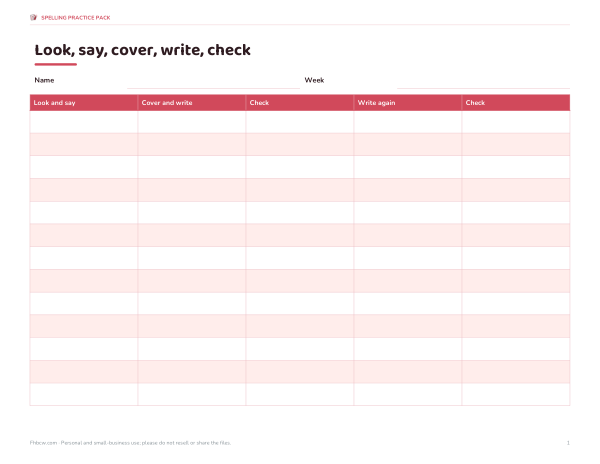
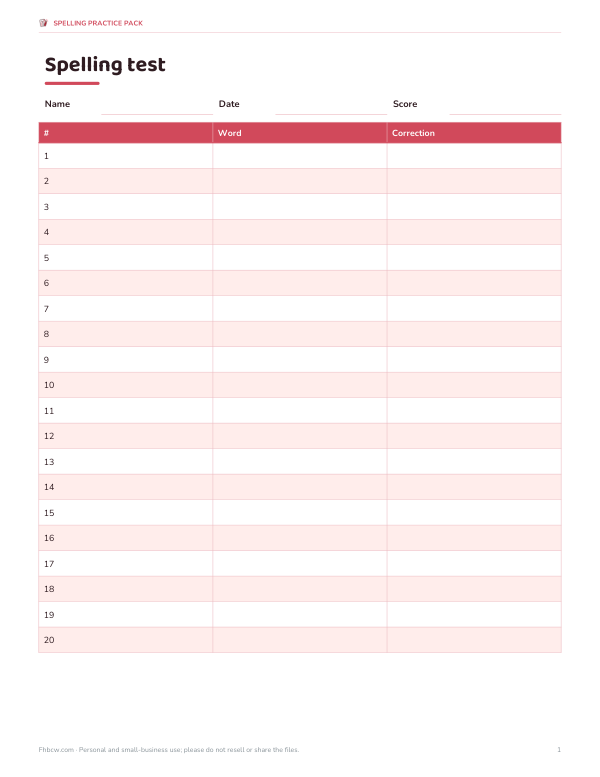
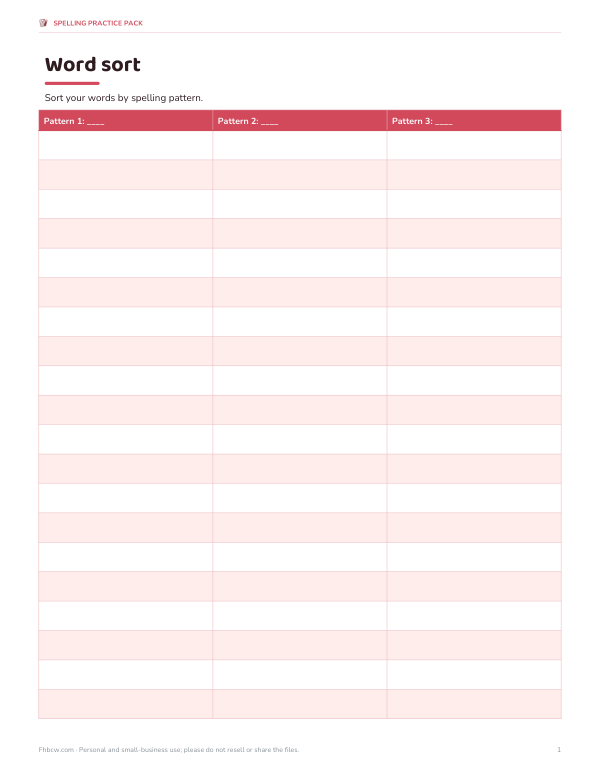
Printable spelling practice templates (look-say-cover-write-check, rainbow writing, word sort, test sheet), a 36-week spelling tracker (Excel) and a list of commonly misspelled words by grade.
- LSCWC template (PDF/DOCX)
- Test sheet (PDF)
- Word sort (PDF)
- Tricky words (PDF)
- Spelling tracker (XLSX)
Formats: PDF, DOCX, XLSX. Instant download after payment (link valid 72 hours, up to 5 downloads). AI-assisted: the templates were drafted with AI help and reviewed and laid out before publishing.
$5.00 USD, one-time 5 files · about $1.00 each
- Instant download
- 7-day refund
- Secure checkout by Stripe
7-day money-back guarantee. Full refund within 7 days of purchase, even after you download.
Free sample: Commonly Misspelled Words (PDF, 56 KB)
Full refund within 7 days — see the refund policy and license.
Free printables
Single sheets you can print right now, no sign-up. The full pack adds every sheet in one download plus the editable files.
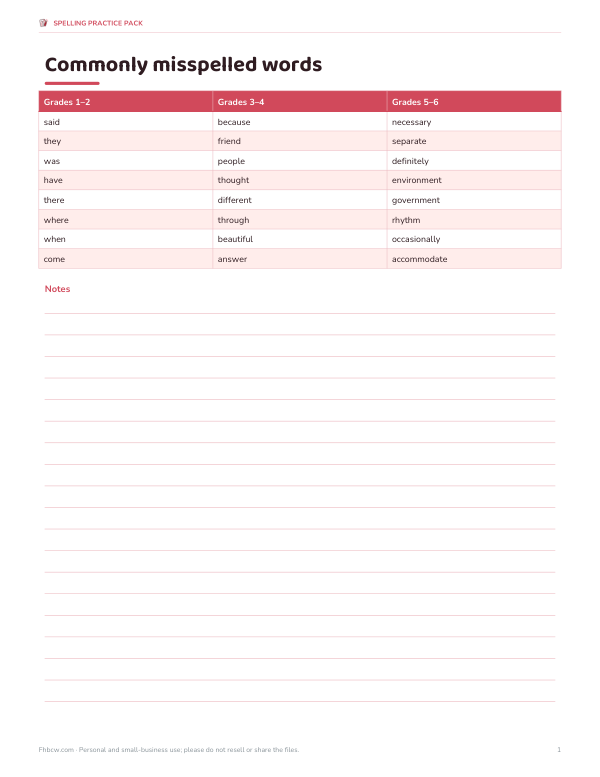 Printable Tricky Words Sheet
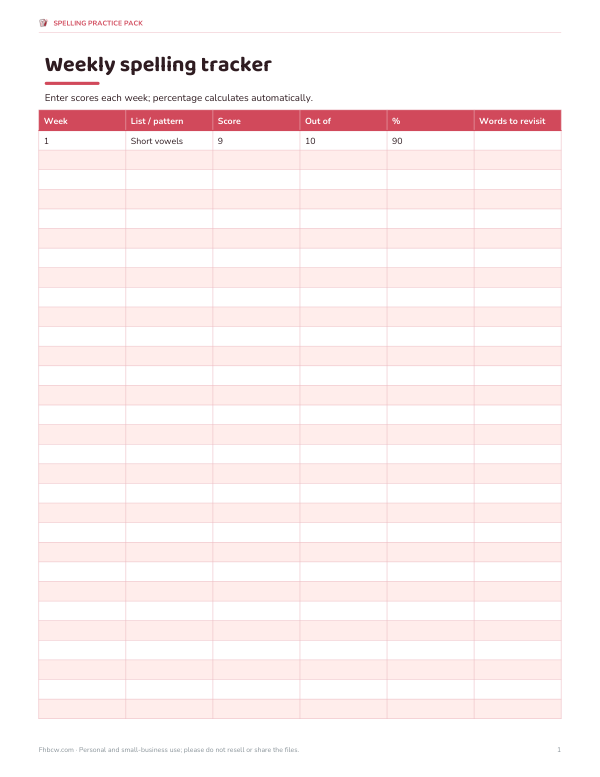 Printable Spelling Tracker Sheet
What the generator makes
Every sheet starts with the child’s name, date and the word list, followed by the activities you tick. Look, say, cover, write, check is the classic memorisation routine. Rainbow writing uses colour and repetition. Missing letters and scrambled words make children think about letter order. ABC order builds dictionary skills, and write a sentence checks meaning and use. Puzzle sections come with an answer key on a second page when you print.
The look, say, cover, write, check method
- Look at the word carefully — notice tricky parts, double letters and silent letters.
- Say it aloud, perhaps in syllables: beau-ti-ful.
- Cover the word.
- Write it from memory.
- Check it against the original, letter by letter, and tick or correct it.
- Repeat for any word that was wrong.
The routine works because it combines seeing, hearing and writing the word, and it gives immediate feedback.
Why a mix of activities helps
Children remember spellings better when they meet words in different ways. Copying alone can become automatic without real attention; puzzles like missing letters and scrambles force careful looking; sentences connect spelling to meaning. Short daily practice — five to ten minutes — beats one long session before the test.
Strategies for tricky words
| Strategy | Example |
|---|---|
| Break into syllables | dif-fer-ent |
| Find a word within a word | b<u>ear</u>, <u>hear</u>t |
| Mnemonics | because: Big Elephants Can Always Understand Small Elephants |
| Say it as it is spelled | Wed-nes-day |
| Word families | thought, bought, brought |
| Highlight the tricky part | friend, people |
Using the sheets at home and at school
- Teachers can generate one sheet per spelling group by pasting different lists.
- Parents can make a Monday sheet from the list sent home and test on Friday.
- Keep sheets in a folder to revise all words before a term test.
- Laminate a sheet and use dry-erase markers for repeated practice.
- Add words children misspell in their own writing — personal lists are powerful.
Worked example
A parent pastes eight Year 3 words — because, friend, people, thought, different, through, beautiful, answer — and ticks four activities. The sheet shows a look-say-cover-write-check table, rainbow writing, missing letters such as “f r _ _ n d” and scrambled versions of each word. The printed answer key lists the words for the missing letter and scramble sections so the child can check their own work. Pressing “New puzzle mix” creates a different set of blanks and scrambles for extra practice.
Spelling test tips
- Say each word, use it in a sentence, then say it again.
- Mix the order rather than following the list.
- Mark together and practise any mistakes straight away.
- Celebrate improvement, not just perfect scores.
- Revisit old words a few weeks later — spaced review helps long-term memory.
Building a weekly spelling routine
| Day | Activity (10 minutes) |
|---|---|
| Monday | Read the list together; look, say, cover, write, check |
| Tuesday | Rainbow writing and missing letters |
| Wednesday | Scrambled words and ABC order |
| Thursday | Write a sentence for each word; practice test |
| Friday | Test, then add any mistakes to next week’s list |
Keeping the same routine each week means children know what to expect and can work more independently.
Choosing words to practise
School lists usually follow a spelling pattern — for example words with “ou”, the “-tion” ending or silent letters — plus a few high-frequency “tricky” words. When you make your own lists, group words that share a pattern so children learn the rule rather than memorising each word separately, and mix in a few review words from earlier weeks. Five to ten words is plenty for younger children; older students can manage fifteen to twenty.
Printing tips
The printed sheet uses your browser’s print dialog: choose portrait, 100% scale and turn off headers and footers for a clean page. The answer key starts on a new page so you can print just the first page for the child. Save as PDF to reuse the same sheet later or share it with another adult who helps with homework.
Spelling and reading together
Spelling and reading reinforce each other. Ask children to find their spelling words in books, signs and packaging, and to use them in their own writing during the week. When a word is misspelled in free writing, praise the attempt, point out the tricky part and add the word to next week’s practice.
Accessibility
The sheets use a clear, large font. For children with dyslexia, try fewer words per sheet, extra spacing, coloured overlays or paper, and more multisensory practice such as writing in sand or with letter tiles.
Privacy
Word lists stay in your browser; nothing is uploaded or stored.
Frequently asked questions
How do I make a spelling worksheet?
Paste the word list, tick the activities you want and print.
How many words can I use?
Up to 20 per sheet.
Is there an answer key?
Yes, it prints on a second page for the puzzle sections.
Can I get a different puzzle?
Yes, press “New puzzle mix” for new blanks and scrambles.
What is look, say, cover, write, check?
A routine for memorising spellings by studying, covering, writing and checking each word.
How many words should a spelling list have?
Five to ten for younger children and up to about twenty for older students.
Can I use the generator for other languages?
Yes, any words you type will work, including accented letters.
What is rainbow writing?
Tracing a word several times in different colours to reinforce the letter order.
Is my list stored?
No, everything happens in your browser.